blog
Foldable container house
24
7 月
7 月
Stacked container houses: the green new favorite and future trend of the export market
Introduction
With the deepening of global trade and the popularization of green building concepts, folding container houses, as a new type of building solution, are emerging in the international market with unique advantages. This modular building, which combines convenience, environmental protection and versatility, not only meets the needs of various countries for rapid deployment and low-cost housing, but also conforms to the global trend of sustainable development. This article will explore the potential and value of folding container houses in international trade from the aspects of export advantages, market demand, technological trends and prospects.
- Export advantages of folding container houses: efficient, environmentally friendly and flexible
The reason why folding container houses have become an ideal choice for the export market is due to their core competitiveness in many aspects: - Efficient transportation and warehousing
The folding design allows its volume to be compressed to 1/3 or even smaller than that of traditional containers, greatly improving transportation efficiency. For example, 40HQ can load 8 sets of folding container houses at a time, greatly reducing the cost of long-distance sea or land transportation. In addition, its modular structure is convenient for stacking storage, reducing storage space occupation, and is particularly suitable for the logistics needs of foreign trade exports. - Rapid deployment and reuse
No need for complex construction, modular steel frame structure and standardized components greatly shorten the project cycle. And the house can be folded and transported repeatedly, with a service life of more than 15 years, and the reuse rate far exceeds that of traditional temporary buildings, reducing the overall cost of overseas projects. - High quality and adaptability
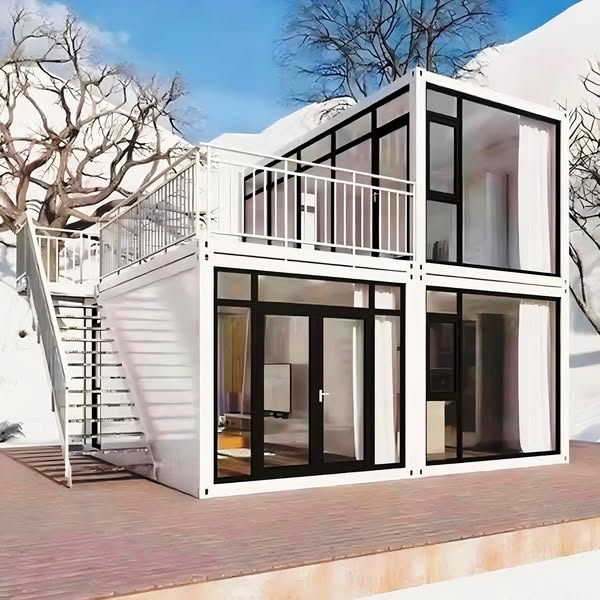
Using materials such as corrosion-resistant C-shaped steel and fireproof rock wool boards, the house has windproof and earthquake-proof, sound-proof and heat-insulating properties, and can adapt to extreme climates and environments. Its steel frame structure can bear the load to build a two-story building, and its safety and stability meet international building standards, meeting the needs of multiple scenarios such as overseas construction sites, camps, and emergency housing. - Environmental sustainability and customization
The production process reduces waste, and the materials can be recycled and reused, which meets the green building specifications. At the same time, the exterior shape and internal layout can be customized according to customer needs, from simple office cabins to smart homestays, which can enhance the competitiveness and market adaptability of export products. - Global market demand: Diverse scenarios drive growth
The export potential of foldable container houses is rooted in the explosion of demand in many fields around the world: - Infrastructure and engineering fields
In countries along the Belt and Road and emerging markets, large-scale infrastructure projects have seen a surge in demand for temporary office and accommodation facilities. The rapid deployment of foldable container houses solves the pain points of long traditional construction cycles and high costs, and has become the first choice for scenes such as construction sites and mines. - Cultural tourism and homestay industry
The recovery of the tourism industry has driven demand for special accommodation. Container houses are widely used in resorts and camping sites with their unique shape and flexibility. For example, the purchase volume of cultural tourism projects in the Yangtze River Delta region accounts for 38% of the country. Its creative design enhances the accommodation experience and has become a new highlight for attracting tourists. - Emergency and rescue scenarios
Natural disaster-prone areas have an urgent need for quickly built shelters. Foldable container houses can be unfolded within 3 minutes and form safe residences in a short time. Their low cost and mobility are significantly better than traditional disaster relief tents. - Urbanization and commercial innovation
In the process of urbanization, container houses have been transformed into commercial spaces such as cafes and micro-stores, becoming “Internet celebrity check-in points” for urban renewal with low cost and high appearance. Data shows that the floor efficiency of some brand container stores is more than twice that of traditional stores, and the commercial value is prominent. - Export challenges and compliance requirements
Despite the significant advantages, the export of foldable container houses still needs to face the following challenges:
● Compliance requirements: It is necessary to obtain an export license and pass the building safety certification of the destination country (such as EU CE certification, US FCC certification, etc.) to ensure compliance with local earthquake resistance and fire prevention standards.
● Logistics adaptability: During transportation, it is necessary to consider the traffic regulations and size restrictions of the destination, and choose open-top containers or split transportation solutions.
● After-sales service system: Establish an overseas installation guidance and maintenance network to ensure customer experience and enhance brand trust.
IV. Future Trends: Technological Innovation and Market Expansion
The export prospects of foldable container houses are broad, and technological iteration and favorable policies will accelerate their global application: - Intelligent and green upgrade
Integrate the Internet of Things and smart home systems to achieve energy management and remote control; adopt new environmentally friendly materials (such as bio-based insulation layers) to further reduce carbon emissions, which is in line with the green building policies of various countries. - Modular customization deepening
AI design tools will promote personalized customization. Users can configure house modules online, and generate them from appearance to function with one click to meet the needs of niche markets and high-end customers. - Emerging market outbreak
The infrastructure gap in Africa, Southeast Asia and other regions, as well as the temporary housing needs of Middle Eastern countries, will continue to drive the purchase of foldable container houses. At the same time, the policy inclination of the European and American markets towards environmentally friendly buildings will open up high-end application scenarios for them. - Policy and industrial chain coordination
As the global container house manufacturing center (accounting for 37% in 2024), China will further reduce export barriers based on the “Belt and Road” initiative and the RCEP trade agreement, and the coordinated optimization of upstream and downstream of the industrial chain (material supply, logistics, installation services) will improve export efficiency.
Conclusion
Folding container houses are becoming the “dark horse” in the global construction market with their efficient transportation, rapid deployment, environmental sustainability and diverse applications. In the field of export, they are not only trade commodities, but also representatives of “Chinese smart manufacturing” and green solutions. With the resonance of technological upgrades and market demand, this type of modular building will play a more important role on the international stage in the future, providing innovative answers to global challenges such as housing shortages, rapid construction, and sustainable development.
(The data in this article refers to industry reports such as China Research and Development and Originality Documents, and is written in combination with market dynamics in 2024-2025)
Date: July 24, 2025
Author: Fang Liang
