blog
Expandable Container Houses: The Future Choice of Modular Architecture
7 月
Abstract: With the acceleration of urbanization and the diversification of housing demands, expandable container houses, due to their flexibility, environmental friendliness, and efficiency, have gradually become a new favorite in the construction industry. This article will deeply explore the advantages and potential of this innovative architectural form from aspects such as design features, expansion methods, application scenarios, and future trends.
I. Introduction: The Revival and Innovation of Container Houses
Container houses, as a typical representative of modular architecture, have been widely used in construction sites, emergency rescue and other fields due to their characteristics of “movability, reusability, and rapid construction”. Expandable container houses have further broken through spatial limitations by ingeniously designing to achieve flexible expansion. They can not only meet temporary needs but also serve as solutions for long-term living or commercial spaces, bringing more possibilities to modern architecture.
II. Design Features: Flexible and Expandable Core Logic
- Double-wing Expansion Structure
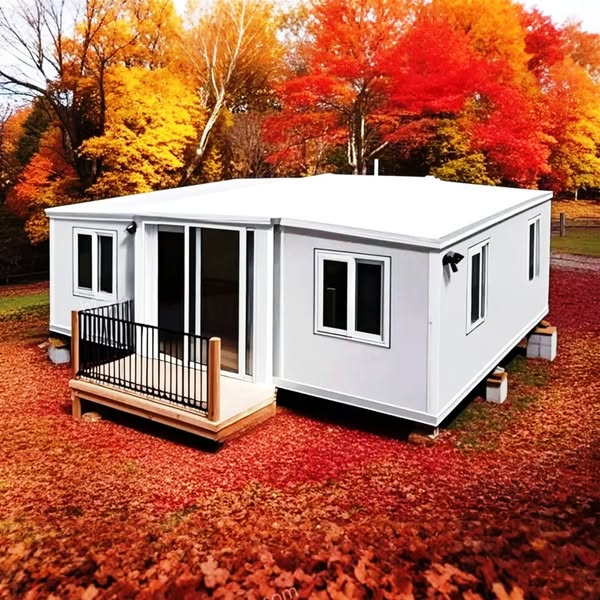
The core of the expandable container house lies in the “double-wing expansion” design, where expansion modules that can be folded or slid are installed on both sides or the top of the container. For example, when more space is needed, the wing plates on both sides can extend outward, instantly increasing the indoor area; when not in use, they can be retracted to their original position, maintaining a compact shape. This design retains the portability of the container while achieving spatial flexibility. - Modular Combination and Stack
Container units support vertical or horizontal stacking to form multi-level or combined buildings. Through standardized interfaces, multiple containers can be quickly connected to form apartments, office buildings, or commercial complexes, further expanding the application scenarios. For example, in a tourist camp, multiple expansion containers can be combined to form a complete residential unit including bedrooms, living rooms, and kitchens. - Integration of Intelligence and Environmental Protection
Modern expandable containers often integrate solar panels, rainwater collection systems, intelligent temperature control equipment, etc., achieving self-sufficiency in energy and environmental protection. At the same time, internal lightweight steel structures and environmentally friendly panels are used, combined with air insulation and heat insulation design, to ensure sound insulation and heat insulation performance, enhancing living comfort.
III. Spatial Expansion Strategy: Multi-dimensional Optimization Design - Efficient Utilization of Interior Space
- Multi-functional Furniture: Folding beds, convertible desks and chairs, built-in storage cabinets, etc. These furniture items free up space when not in use, meeting the demand for “one room with multiple uses”.
- Vertical Space Development: Install shelves on the walls, hanging storage cabinets, and set up hammocks or chairs on the ceiling to maximize the use of three-dimensional space.
- External Expansion Modules
- Terrace and Balcony: Build retractable terraces on the exterior of the box to expand the outdoor leisure area, and also for storing equipment or plants.
- Additional Function Units: Install solar power modules on the top or connect separate functional cabins such as bathrooms and kitchens on the sides to achieve functional expansion.
- Open and Partition Design
Use elements such as glass partitions and sliding wall panels to achieve visual connection and flexible partitioning of the space, maintaining transparency while allowing for the division of office areas and living areas as needed.
IV. Application Scenarios: Diverse Needs from Temporary to Permanent - Emergency Response and Disaster Relief
In cases of natural disasters or emergency rescue operations, the expansion box can be quickly deployed as a temporary hospital, shelter, or command center. Its rapid expansion feature can efficiently accommodate more affected people. - Construction Sites and Urban Infrastructure
As workers’ dormitories or temporary offices, the expansion box can be combined through stacking to form a small community, saving land costs and being reusable as the project progresses. - Tourism and Homestays
The expansion box homestays in scenic spots and campsites can provide unique accommodation experiences through customized design and integration with the external landscape. The double-wing expansion structure can create transparent viewing spaces, attracting tourists. - Urban Residential Innovation
In densely populated urban areas, the expansion box can serve as a mini apartment, formed through modular combination into a vertical community to alleviate housing pressure. Its environmental friendliness and low cost advantages align with the concept of sustainable development.
V. Future Trends: Integration of Standardization and Intelligence
With technological advancements and growing market demands, expandable container houses are evolving towards a direction of standardization, intelligence, and environmental friendliness:
- Standardized Production: Industry standards are gradually improving (such as the “Technical Regulations for Containerized Modular Combination Housing”), promoting the standardization of modular components and reducing manufacturing and assembly costs.
- Intelligent Upgrade: Integrating the Internet of Things system, it enables remote control, energy management, and security monitoring, enhancing living convenience and safety.
- Green Technology Application: Environmental protection technologies such as photovoltaic building integration, the application of recycled materials, and water-saving systems will be further developed, contributing to the construction of a low-carbon city.
- Market Expansion Potential: Data shows that the global market for containerized housing will reach 18 billion US dollars in 2024, with China accounting for 37% and ranking first. The demand for emerging scenarios such as tourism, emergency medical care, and smart office is growing at a rate of over 60%, indicating a broad industry prospect.
VI. Conclusion: The Possibility of Reshaping Architecture and Life
The expandable container house is centered on “flexibility”, breaking the inherent boundaries of traditional architecture. It not only solves problems such as temporary housing and efficient use of space, but also endows the building with the ability to “grow” through innovative design. Under the impetus of the dual demands of urbanization and sustainable development, this modular architectural form is bound to see wider application and bring revolutionary changes to human living patterns.
